
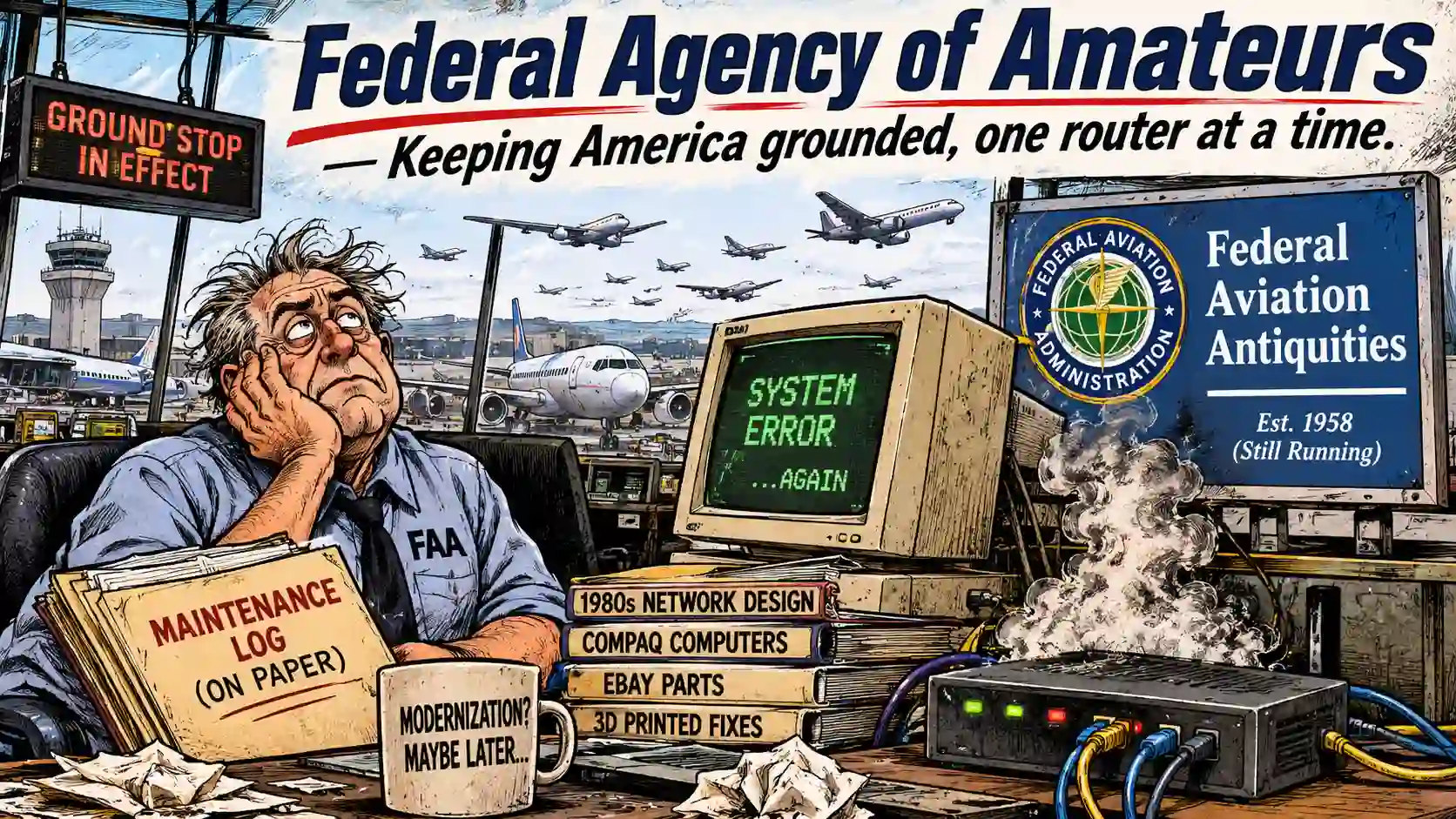
One Router Away: America’s Air Traffic System Is a National Embarrassment
On Friday afternoon, November 13, 2026, the most sophisticated air traffic system in the world brought American aviation to a standstill.
Not because of a hurricane. Not because of a terrorist attack. Not because of some exotic cyberweapon. A technician disconnected an obsolete copper telephone line, connected a new fiber installation, and a router promptly began behaving like a drunken telemarketer, hammering the network with connection requests faster than it could process them.
One router. Seventeen air traffic control centers. An entire country’s aviation system on its knees.
If that sounds absurd, that’s because it is. Unfortunately, it’s also the state of American infrastructure.
What actually happened
The timeline is almost as embarrassing as the underlying failure.
- 3:44–3:54 p.m. ET — The FAA issues a nationwide ground stop, citing “extraordinary circumstances and for reasons of safety.” Departures are halted. Incoming flights are handled individually. Some international departures receive exceptions to help clear airport congestion.
- Approximately 3,500 aircraft are already airborne. Controllers and pilots manage to get them safely through the disruption. The humans, it turns out, are considerably more dependable than the technology they’re expected to operate.
- 8:15 p.m. ET — The airspace reopens. Four and a half hours of nationwide disruption, the longest grounding since September 11, 2001.
- The aftermath: More than 20,000 flights were caught up in Friday’s disruption. The FAA reportedly accommodated approximately 8,000 flights after reopening, while thousands of others were canceled or delayed. Flight-tracking services reported nearly 10,000 cancellations by late evening. The FAA’s separate estimates of approximately 9,000 commercial and 3,000 general-aviation flights that did not operate appear to use different reporting categories or methodologies; these figures should not be added together. The disruption continued into Saturday, when another 4,000–5,000 cancellations were reported.
Aircraft were stranded at gates for hours. Crews exhausted their duty limits. Planes, passengers, and personnel ended up in the wrong places. And because aviation is an interconnected logistical system, Friday’s failure didn’t end Friday night. It propagated into the weekend.
The precise flight totals vary depending on what is being counted. The scale of the disruption does not.
All because one router couldn’t behave itself.
Why It Happened: Welcome to the Technological Dark Ages
The immediate culprit
Transportation Secretary Sean Duffy’s explanation is remarkably specific.
- Contractor L3Harris was replacing an aging copper telecommunications connection with fiber at a remote FAA facility. The copper infrastructure was so decrepit that the telephone company was discontinuing service. Apparently, the FAA had reached the point where its infrastructure was being retired by someone else’s maintenance schedule.
- The replacement router began flooding other routers across the air traffic control network with more than 1,000 connection attempts every four to five seconds.
- 17 of 22 Air Route Traffic Control Centers experienced instability affecting voice communications, ground communications, and radar feeds.
- It took 45 minutes just to identify the problem.
Why?
Because maintenance work at the FAA is logged on paper.
That’s right. In 2026, when a failure can ground thousands of aircraft and disrupt an entire national transportation network, technicians are still physically consulting paper records to determine who worked on what.
Apparently, the agency’s digital transformation hasn’t quite made it to the filing cabinet.
The underlying disaster
The router was the trigger. The architecture was the powder keg.
The FAA’s telecommunications infrastructure is substantially rooted in a design dating back to the 1980s. Administrator Bryan Bedford has described facilities operating on individual Compaq computers — a brand that stopped manufacturing PCs in 2013.
Replacement parts? Sometimes eBay. Sometimes 3D printing.
Let that sink in. The United States operates one of the world’s most consequential aviation networks using infrastructure whose maintenance strategy occasionally resembles a hobbyist’s weekend electronics project.
And this isn’t simply anecdotal embarrassment. The Government Accountability Office’s March 2025 assessment found:
- Of 138 air traffic control systems, 51 were classified as “unsustainable.”
- Another 54 were considered “potentially unsustainable.”
- Of those 105 systems, 73 had been deployed more than 20 years ago, 40 more than 30 years ago, and six more than 60 years ago.
- Fifty-eight had a critical operational impact.
- Seventeen were identified as particularly concerning, with modernization at least six years away for thirteen of them.
This isn’t a handful of neglected computers in some forgotten basement. It’s a systemic infrastructure problem documented, quantified, and apparently tolerated.
There’s another rather uncomfortable detail: the network itself isn’t even entirely government-owned.
According to Duffy, L3Harris actually owns the network.
The federal government controls American airspace, but a defense contractor owns the telecommunications plumbing that helps keep it functioning.
So we have an aging architecture, fragmented accountability, outsourced infrastructure, paper maintenance records, and replacement components sourced from online auctions.
What could possibly go wrong?
The institutional instinct: declare victory over the explanation
Within hours, officials were eager to establish what the incident wasn’t.
Not a cyberattack. Not an AI rogue agent. “Zero evidence of anything nefarious.”
Fine. Perhaps it wasn’t.
But notice the institutional reflex: quickly eliminate the most alarming explanations, reassure the public, and move along. The more interesting question — why a routine infrastructure upgrade could destabilize seventeen control centers and halt departures nationwide — deserves considerably more attention than it received.
The failure wasn’t necessarily malicious. It was arguably worse: it was mundane, systemic negligence.
A contractor performed routine maintenance. A router malfunctioned. The network couldn’t contain the problem. The FAA couldn’t immediately identify the cause because its maintenance records were on paper.
No sophisticated adversary required. No elaborate plot. Just ordinary institutional incompetence meeting extraordinary operational dependence.
And, conveniently, there’s a funding request.
Duffy had previously sought $30 billion on top of the $12.5 billion Congress approved in July 2025. Following Friday’s debacle, his request jumped to $50 billion.
Apparently, it takes a nationwide aviation shutdown to make the price of deferred maintenance politically compelling.
Why This Is Going to Happen Again
Friday wasn’t an isolated incident. It’s the latest entry in an increasingly familiar catalog of infrastructure failures.
- January 2023: The FAA’s NOTAM system collapses, triggering the first nationwide ground stop since 9/11 and disrupting approximately 11,000 flights.
- Spring 2025: Repeated radar and communications failures plague Newark.
- September 2025: A contractor cuts fiber lines near Dallas, disrupting thousands of flights.
- September 2026: A circuit failure at a Philadelphia facility, combined with a severed fiber cable in New Jersey, disrupts the Northeast.
- November 13, 2026: One malfunctioning router destabilizes seventeen control centers and grounds the country.
Different components. Different locations. Different immediate causes.
The common denominator is an infrastructure system that has accumulated decades of technical debt while becoming increasingly intolerant of failure.
And here’s the particularly unpleasant part: the modernization effort intended to fix this problem introduces an entirely new set of opportunities to make it worse.
The cure could be another disease
The FAA is undertaking a massive infrastructure conversion: thousands of copper connections being replaced with fiber and IP-based communications across approximately 4,600 sites.
The undertaking involves tens of millions of labor hours, dozens of vendors, and a target completion date in late 2027.
Think about the operational implications.
An already fragile national network is undergoing a vast, coordinated transformation involving thousands of facilities, multiple contractors, legacy equipment, and new telecommunications infrastructure.
Every cutover is an opportunity for configuration errors, interoperability problems, unexpected dependencies, and failures that weren’t anticipated in the design documents.
Modernization is necessary. Nobody seriously disputes that. But replacing obsolete infrastructure at this scale, while continuing to operate a mission-critical national transportation system, is not a trivial IT refresh.
It is a high-stakes engineering exercise in which the margin for error is measured in human lives, not merely help-desk tickets.
And if the existing infrastructure cannot reliably tolerate a single router misbehaving, what confidence should anyone have in the agency’s ability to execute thousands of technology transitions?
The Bottom Line
The United States doesn’t have an air traffic control problem caused by one bad router.
It has an institutional problem that allowed one bad router to become a national aviation emergency.
We have known about the obsolete systems. We have known about the unsustainable equipment. We have known about the modernization backlog. We have watched repeated failures expose the same weaknesses, year after year.
And yet, here we are.
A contractor owns critical network infrastructure. Technicians consult paper maintenance records. Computers are old enough to qualify for Social Security. Replacement parts come from eBay. And a routine telecommunications upgrade can bring American departures to a halt.
The FAA’s people deserve credit for keeping thousands of aircraft safe during the disruption. They did their jobs under extraordinary circumstances.
The institution responsible for giving them dependable tools and infrastructure has some explaining to do.
Because a national airspace system should not be one router away from paralysis.
And if it is, the problem isn’t the router.